Lecture 09 — Color
Lecture 09
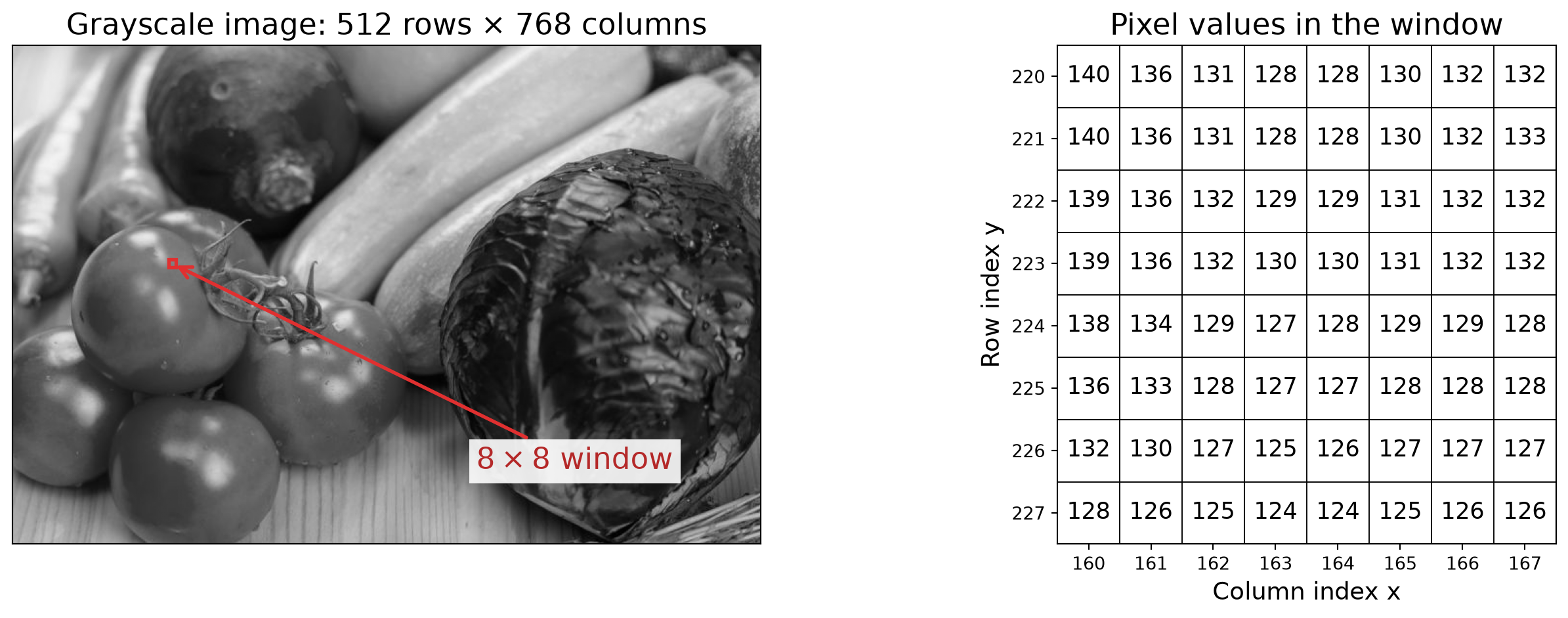
RGB Images Have Three Channels
- An RGB image contains three \(H \times W\) matrices: red, green, and blue.
- Together, they form an array with shape \((H,W,3)\).
\[ I(y,x)=\begin{bmatrix}R(y,x)&G(y,x)&B(y,x)\end{bmatrix} \]

- Each pixel has three values. For example, \((255,0,0)\) is red and \((255,255,255)\) is white.
Light and Wavelength
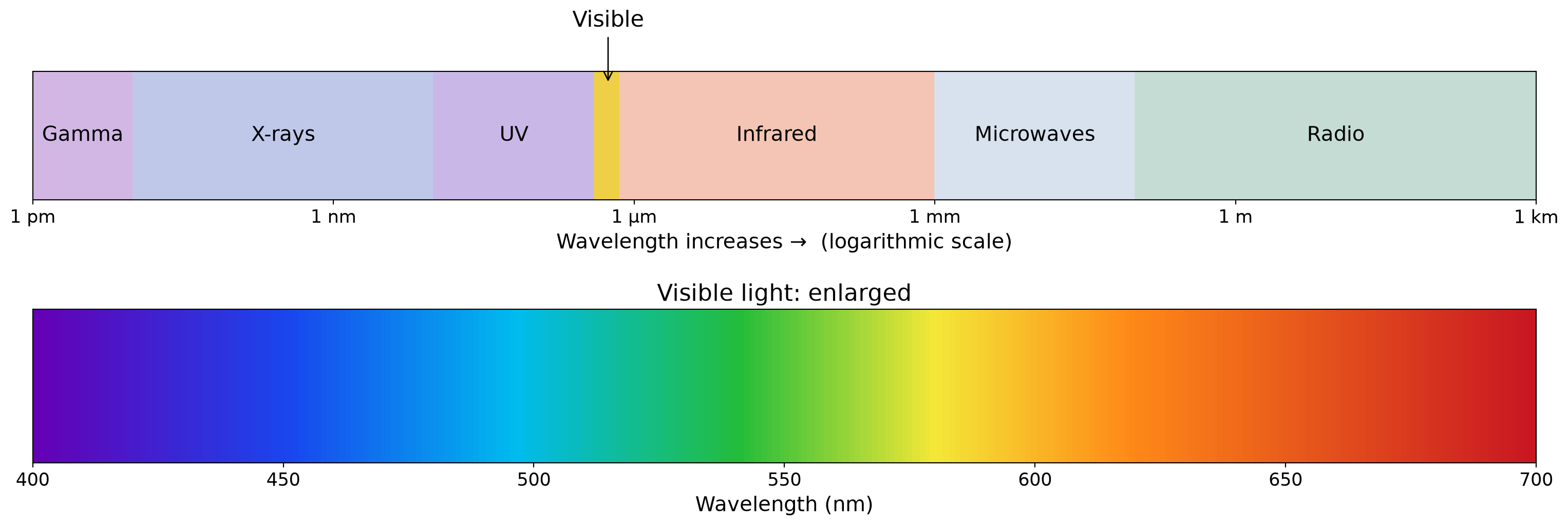
- Visible light is a small part of the electromagnetic spectrum, approximately 400–700 nm.
- A single wavelength has a spectral color. Most light reaching a camera contains a mixture of wavelengths.
Human Color Perception
- In daylight, color vision relies on three types of cone cells: S, M, and L.
- Their sensitivities overlap. Color depends on the combination of their responses.
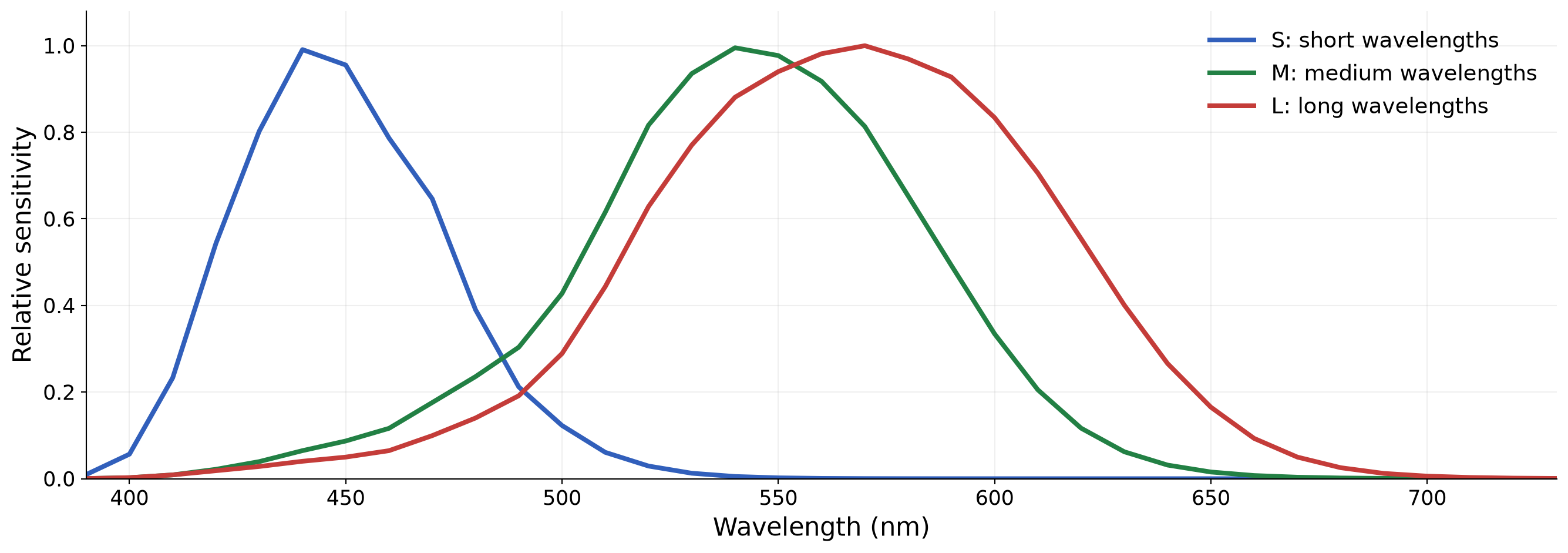
- S, M, and L refer to wavelength sensitivity; they are not the RGB channels of an image.
How Cameras Capture Color
- Three sensors: a prism separates light into three paths, one for each color channel.
- One sensor: a color filter array lets each sensor location measure one color component.
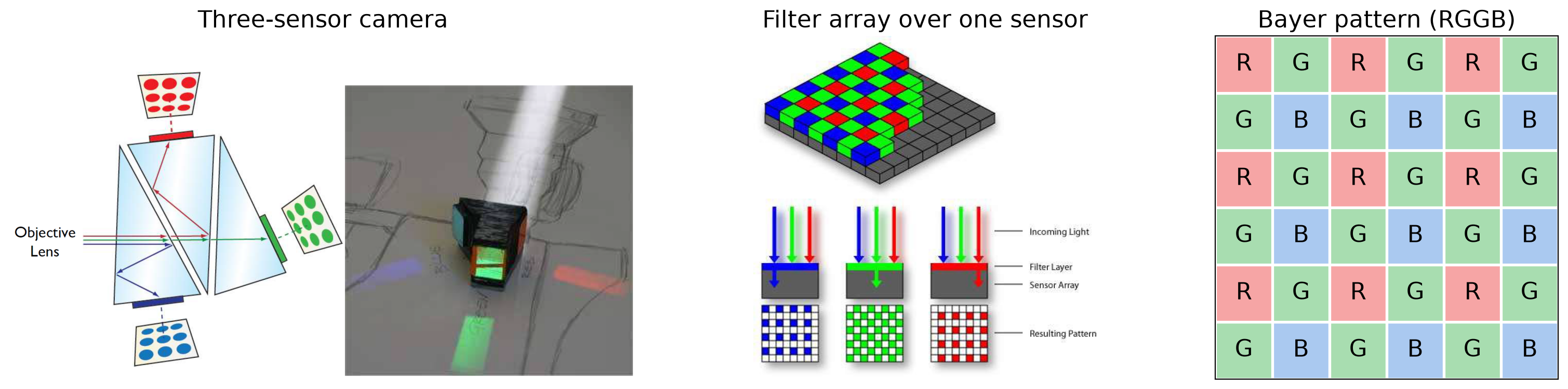
- Each \(2\times2\) Bayer block contains two green, one red, and one blue sample.
- Human vision is most sensitive to green, where the M and L cones overlap, so green carries most of perception.
- The missing color components must be estimated to obtain an RGB image.
Reconstructing RGB: Demosaicing
Demosaicing estimates the two missing color components at each sensor location using nearby samples.
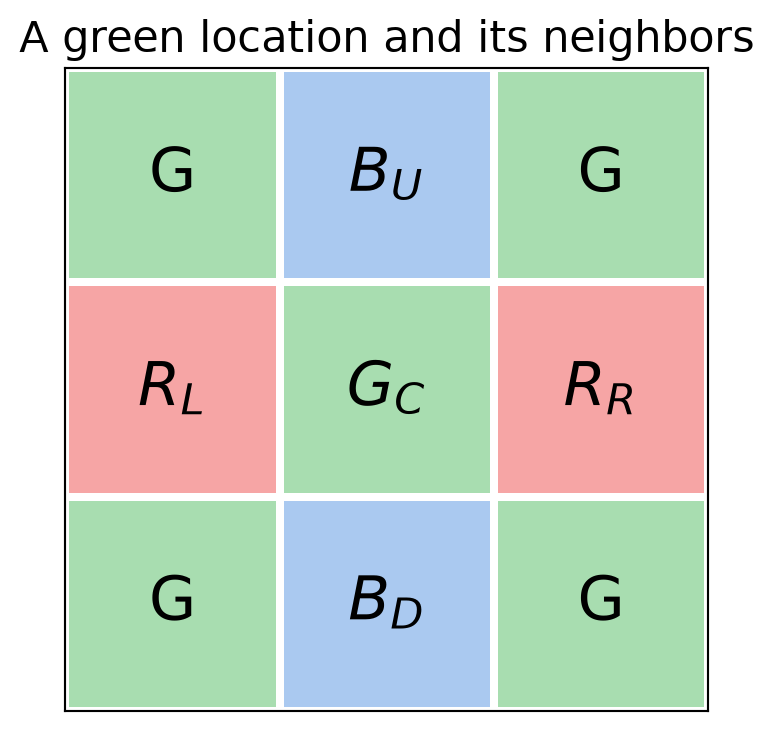
At the center, green is measured directly:
\[ \widehat G_C = G_C \]
Estimate red and blue by averaging nearby samples:
\[ \widehat R_C = \frac{R_L+R_R}{2}, \qquad \widehat B_C = \frac{B_U+B_D}{2} \]
The reconstructed pixel is
\[ \widehat I_C = \begin{bmatrix}\widehat R_C & G_C & \widehat B_C\end{bmatrix}. \]
- This is a simple bilinear interpolation example. The neighbors used depend on the location’s filter color and position in the Bayer pattern.
Color Spaces: RGB
- A color space represents colors numerically. RGB uses red, green, and blue components and is widely used for images and displays.
- RGB is an additive model: adding colored light produces brighter colors.
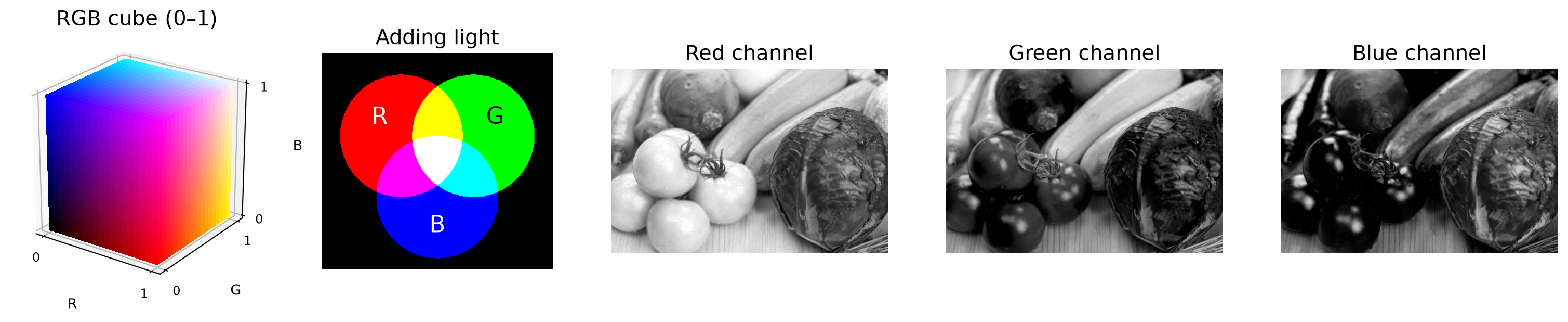
OpenCV loads BGR, so we convert to RGB before splitting. In the channel images, brighter pixels mean larger values (0–255).
CMYK: Color for Printing
- CMYK uses cyan, magenta, yellow, and black inks in a subtractive model: inks absorb light.
- Used for printing. The code below illustrates a simplified conversion; actual printing uses color profiles.
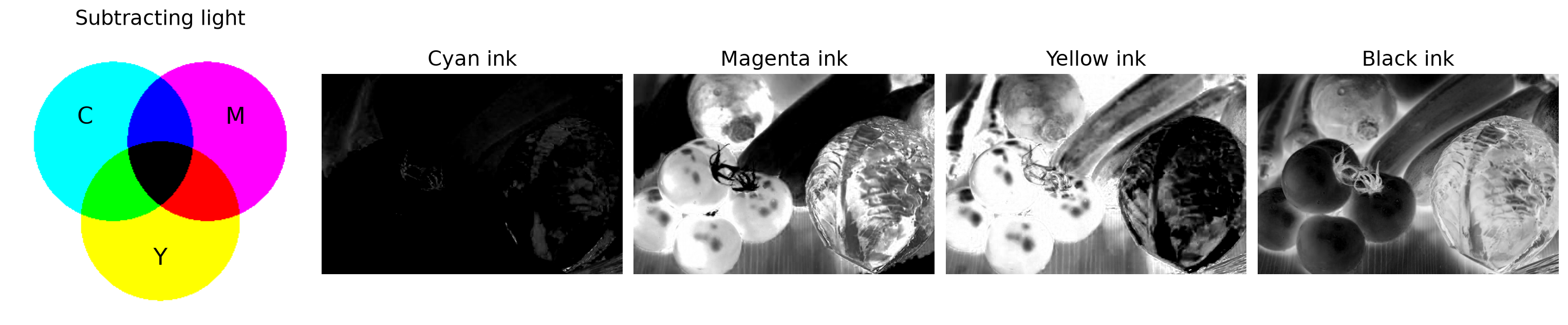
Channel values range from 0 to 1; brighter pixels indicate more ink. OpenCV has no direct CMYK conversion, so this example uses NumPy.
HSV: Hue, Saturation, and Value
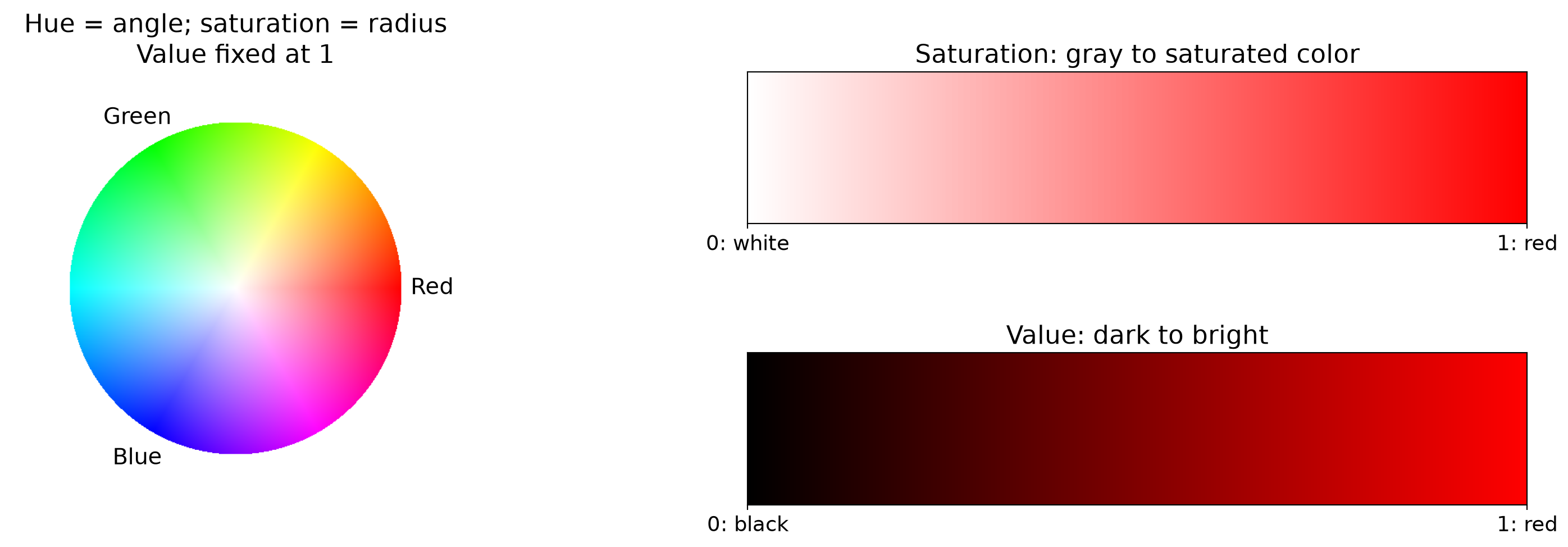
- Hue describes the color, saturation its departure from gray, and value the largest RGB component.
- HSV is useful for selecting and tracking objects by color.
HSV in Python
- Hue separates colors; saturation and value help exclude nearly gray or very dark pixels.
- Hue is unreliable when saturation or value is very small.
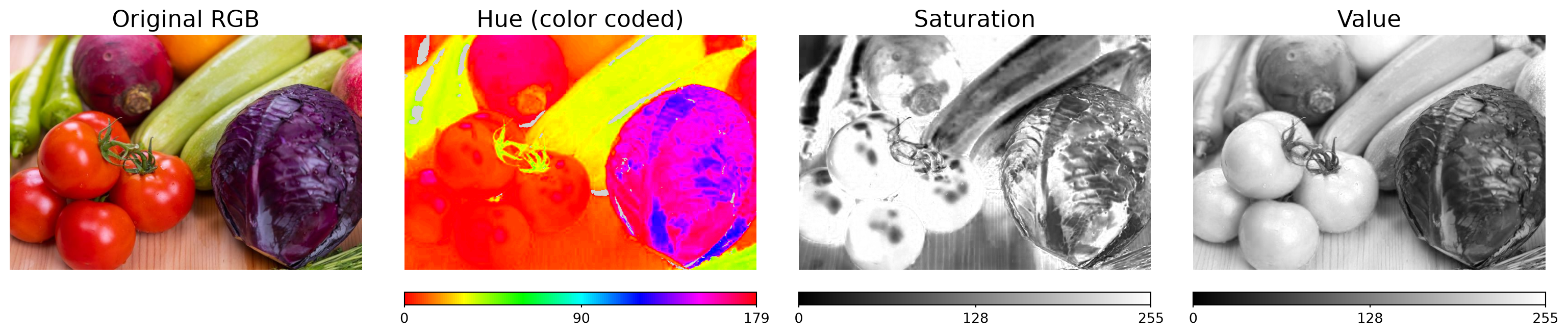
For 8-bit OpenCV images: \(H\in[0,179]\) (approximately half the angle in degrees), and \(S,V\in[0,255]\).
YCbCr: Luma and Chroma
- Y represents luma; Cb and Cr represent blue- and red-difference chroma.
- Used in image/video compression: chroma can be stored at lower resolution than luma.
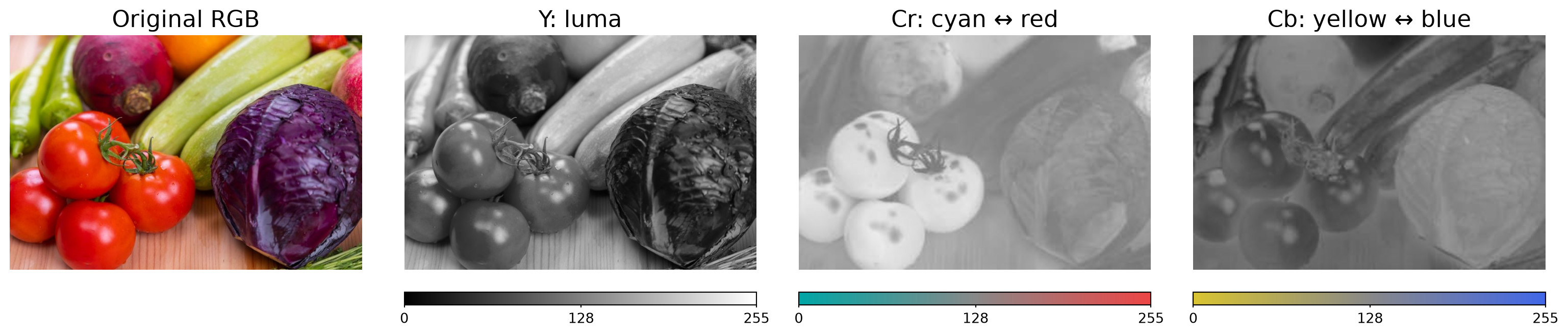
OpenCV returns channels in Y, Cr, Cb order. For 8-bit images, neutral chroma is approximately 128.
CIELAB: Lightness and Color Differences
- \(L^*\) describes lightness; \(a^*\) runs from green to red, and \(b^*\) from blue to yellow.
- Approximately perceptually uniform: distances are useful for comparing colors and grouping similar colors.
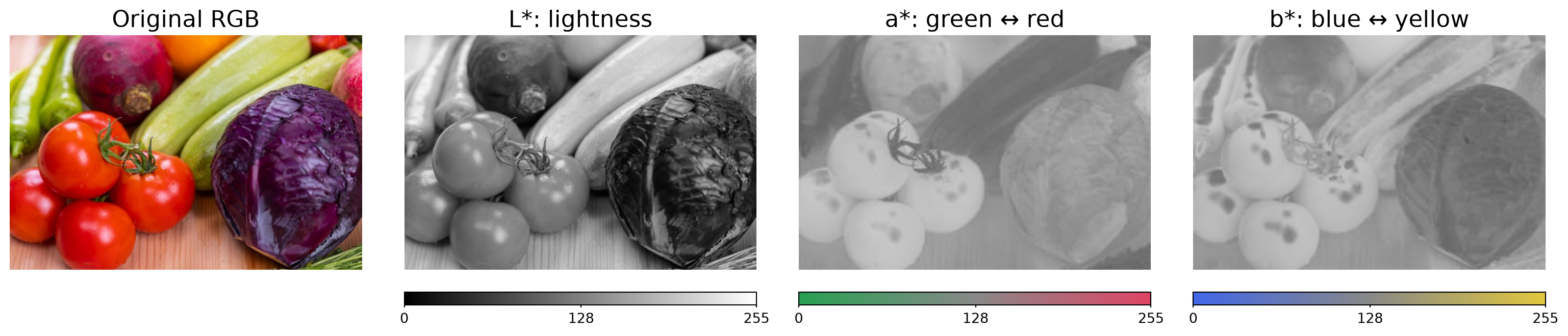
OpenCV’s 8-bit encoding: \(L_8=255L^*/100\), \(a_8=a^*+128\), \(b_8=b^*+128\). Neutral \(a^*=b^*=0\) is stored as 128.
Color-Based Segmentation
- Select red pixels in HSV. Red wraps around the hue scale, so we combine two hue ranges.
- Minimum saturation and value thresholds reject weak colors and dark pixels.
hsv = cv2.cvtColor(frame, cv2.COLOR_BGR2HSV)
mask = cv2.inRange(hsv, (0, 130, 80), (5, 255, 255)) # returns 255 for matching pixels, 0 otherwise
mask |= cv2.inRange(hsv, (170, 130, 80), (179, 255, 255)) # |= combines the masks
mask = cv2.morphologyEx(mask, cv2.MORPH_CLOSE, np.ones((3, 3), np.uint8)) # fills small gaps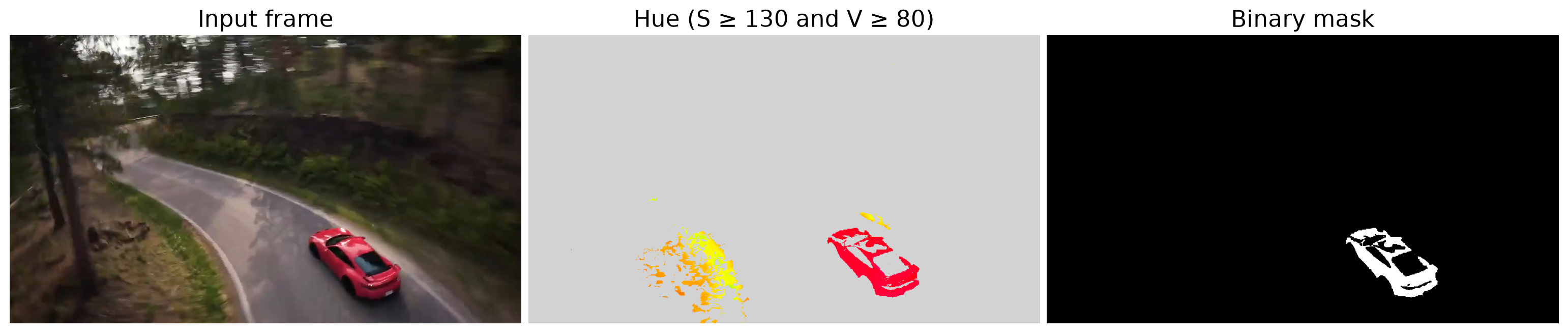
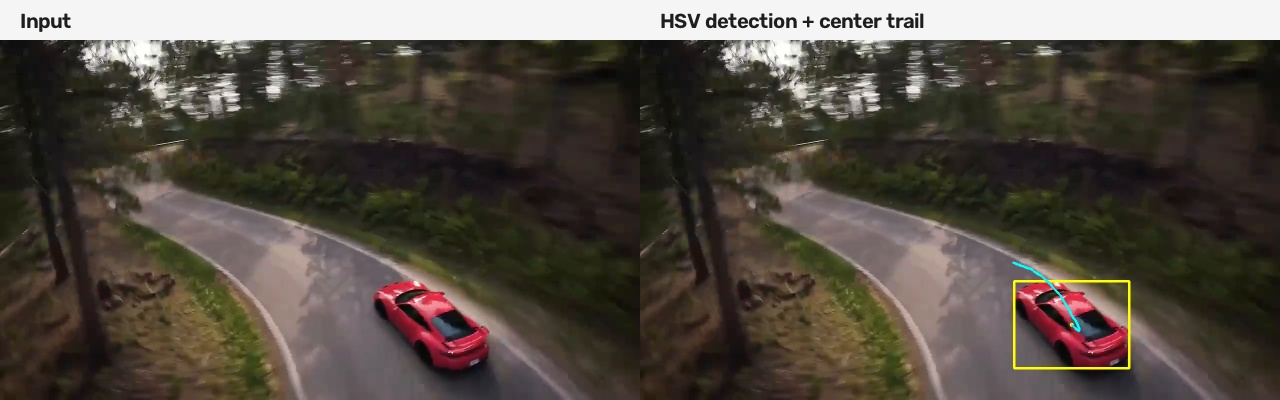
Color-Based Tracking: Result
- Yellow box: detected red region.
- Cyan line: the last 40 detected centers.
- The trail is in image coordinates, so it also reflects camera motion.