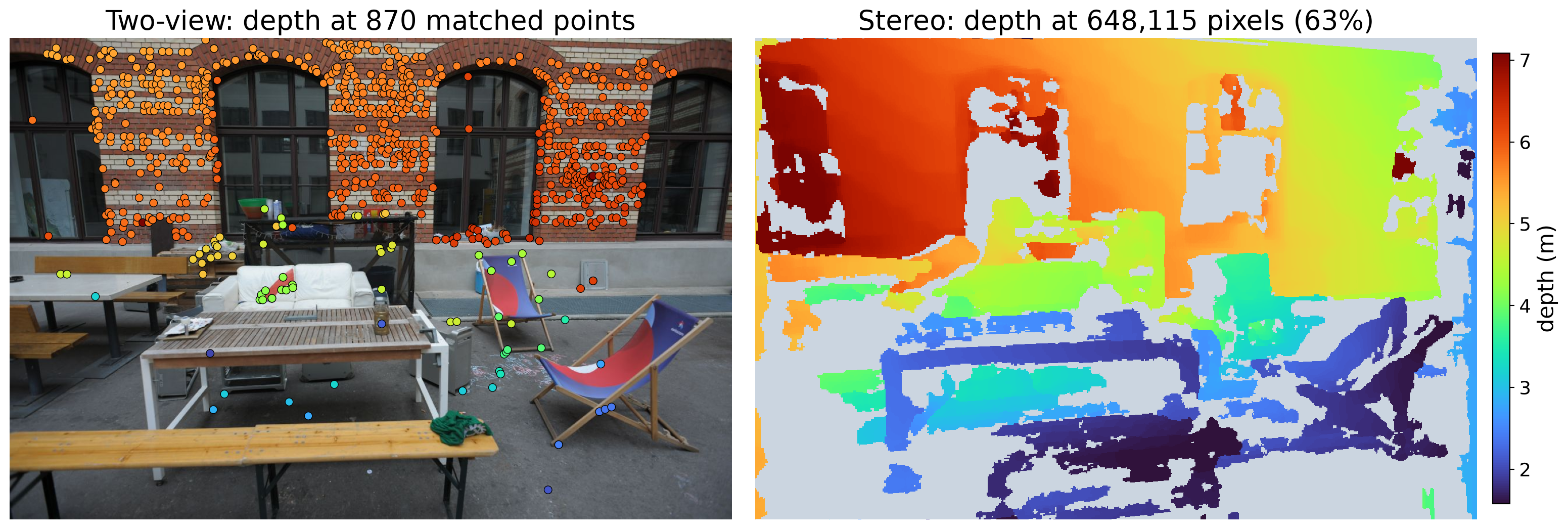
Lecture 14 — Stereo Vision
Lecture 14
The Stereo Setup

- Two calibrated cameras side by side, same orientation, a baseline \(b\) apart.
- Each point stays on the same row and shifts left by the disparity \(d\). Near points shift more.
Stereo Reconstruction
Rectify the images to side by side \(\rightarrow\) match each pixel along its row \(\rightarrow\) disparity \(\rightarrow\) depth \(\rightarrow\) 3D points
Disparity Gives Depth

\[ \bbox[border: 2px solid #c53030; padding: 2px 6px]{Z = \frac{f\,b}{d}}\;\;{\color{#c53030}{\begin{array}{l}\textbf{depth from}\\ \textbf{disparity}\end{array}}} \]
- \(f\): focal length (px), \(b\): baseline (m), \(d\): disparity (px).
- Twice as far \(\rightarrow\) half the disparity. Very far: \(d \rightarrow 0\).
Depth From Disparity: A Numerical Example
The three points from the stereo setup:
- Measure the columns \(x_L\) and \(x_R\).
- Disparity: \(d = x_L - x_R\).
- Depth: \(Z = f\,b\,/\,d\).
Rig: \(f\) = 500 px, \(b\) = 0.5 m, so \(f\,b\) = 250 px·m.
| Point | \(x_L\) (px) | \(x_R\) (px) | \(d\) (px) | \(f\,b\,/\,d\) (m) | True \(Z\) (m) |
|---|---|---|---|---|---|
| near | 257.5 | 132.5 | 125.0 | 2.00 | 2.00 |
| middle | 461.7 | 378.3 | 83.3 | 3.00 | 3.00 |
| far | 355.0 | 305.0 | 50.0 | 5.00 | 5.00 |
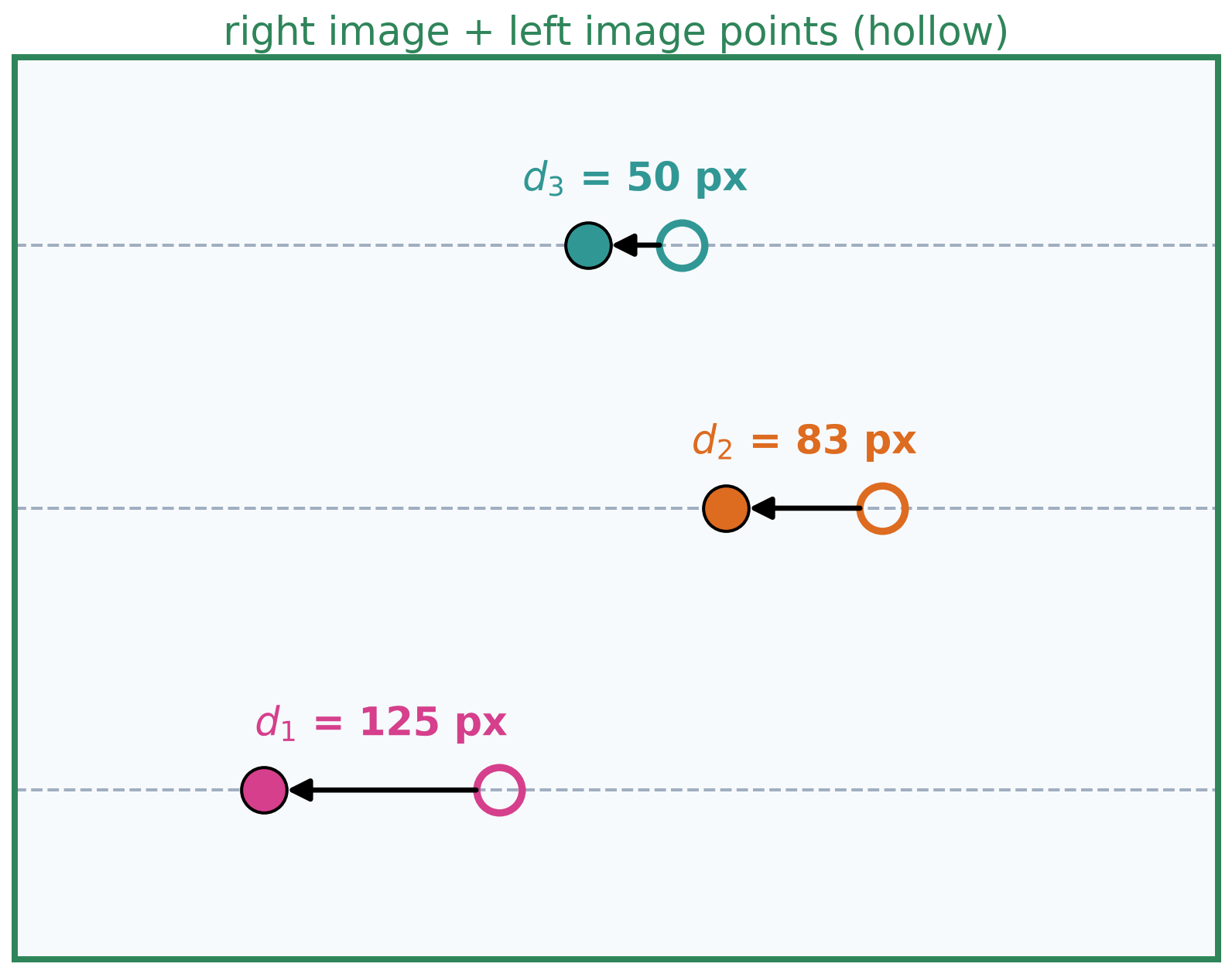
- \(f\) in pixels and \(b\) in meters \(\rightarrow\) \(Z\) in meters. The depths match the true ones.
(Supplementary) Why \(Z = f\,b\,/\,d\): Similar Triangles
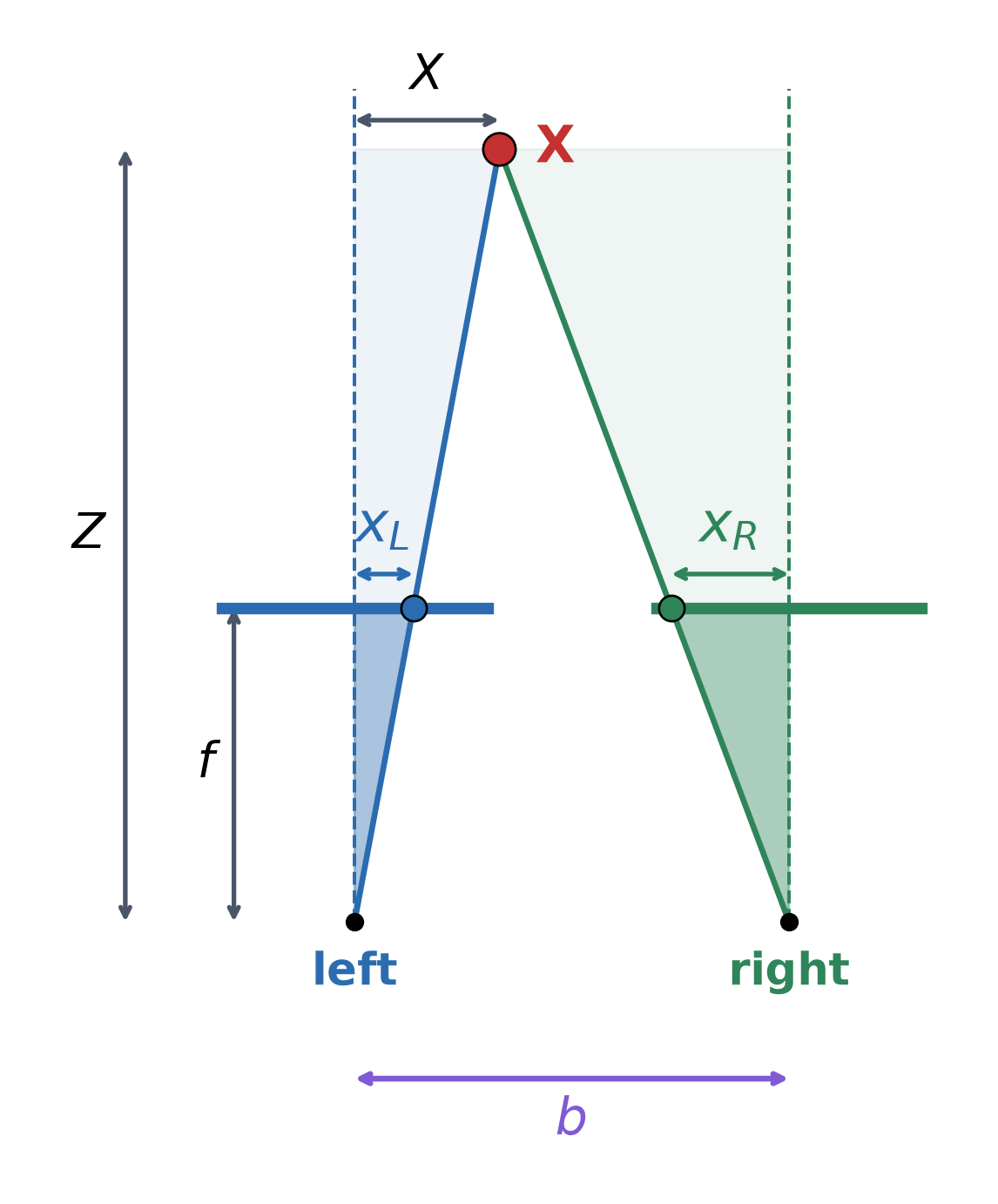
- Image coordinates are measured from each camera’s optical axis.
- Left camera: the small and large blue triangles are similar: \[\frac{x_L}{f} = \frac{X}{Z}\]
- Right camera: the same, with the point at \(X - b\) from its axis: \[\frac{x_R}{f} = \frac{X - b}{Z}\]
- Subtract: \[d = x_L - x_R = \frac{f\,b}{Z} \;\;\Rightarrow\;\; Z = \frac{f\,b}{d}\]
Depth Precision Falls With Distance
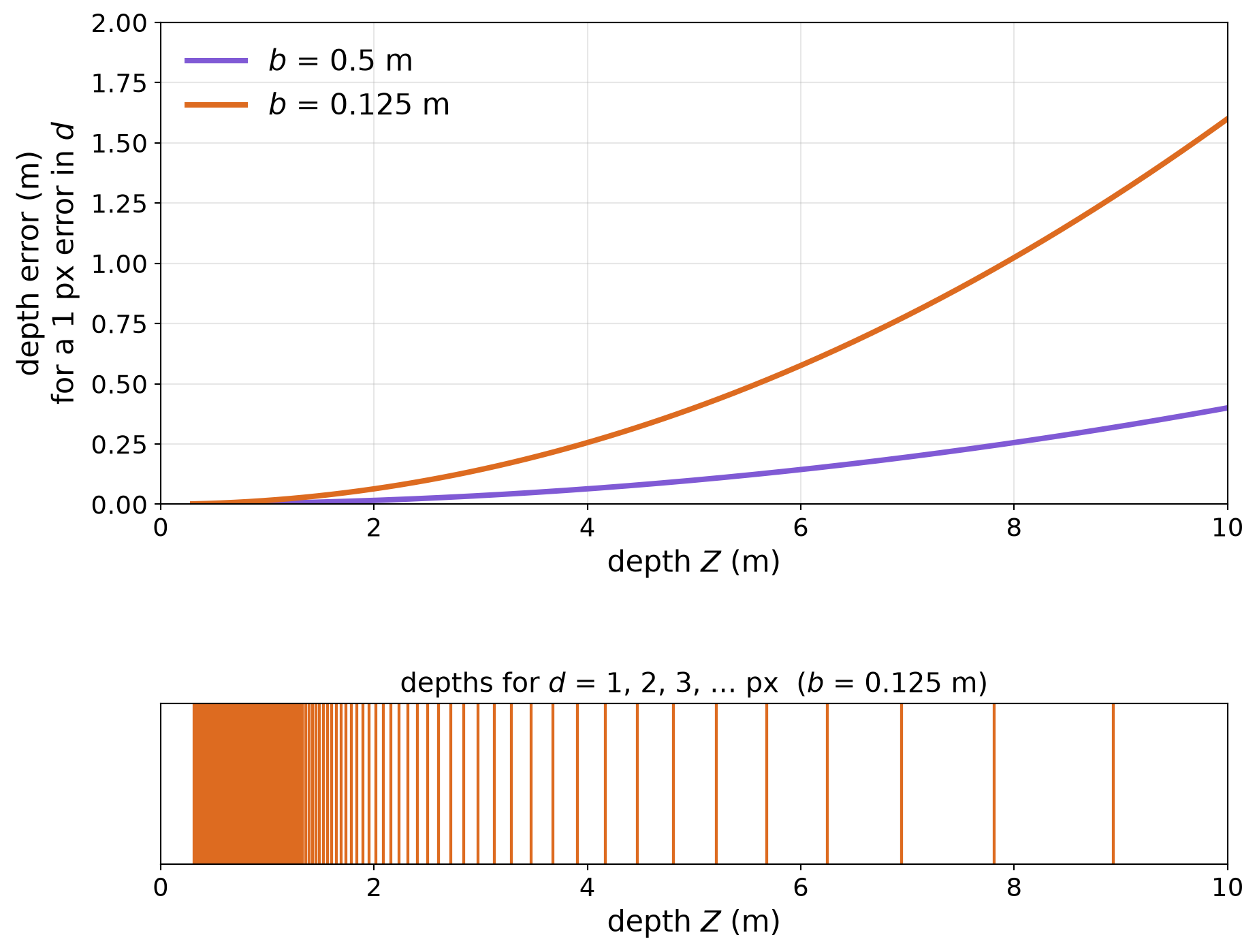
\[\Delta Z \approx \frac{Z^2}{f\,b}\,\Delta d\]
- Error grows with \(Z^2\): twice as far, four times the error.
- A longer baseline \(b\) or focal length \(f\) helps, but makes matching harder (bigger search, more occlusion).
- Same idea as parallax in two-view triangulation.
| \(Z\) | \(b\) = 0.5 m | \(b\) = 0.125 m |
|---|---|---|
| 2 m | ± 2 cm | ± 6 cm |
| 5 m | ± 10 cm | ± 40 cm |
| 10 m | ± 40 cm | ± 160 cm |
Image Rectification
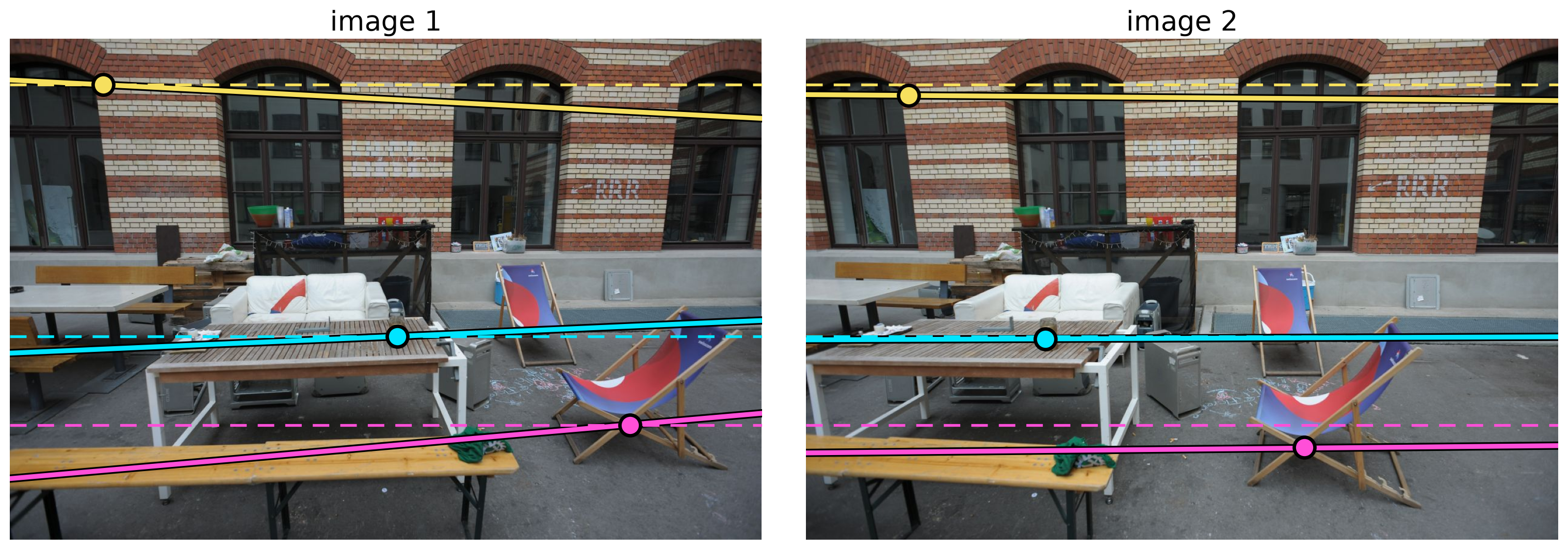
- If camera 1 and camera 2 are not perfectly aligned side by side, the epipolar lines will be slanted in the images.
- A match is not on the same row (dashed), but a different slanted epipolar line.
- Rectification warps both images so that every epipolar line becomes the same row in both.
Rectification: Rotate the Cameras Virtually

- Turn each camera about its center until both face the same way, perpendicular to the baseline (purple).
- Pure rotation \(\rightarrow\) each image is warped by a homography \(\mathbf{H}_i\) (as in two-view).
- The epipoles move to infinity: epipolar lines become horizontal, and matches land on the same row.
Rectification With OpenCV
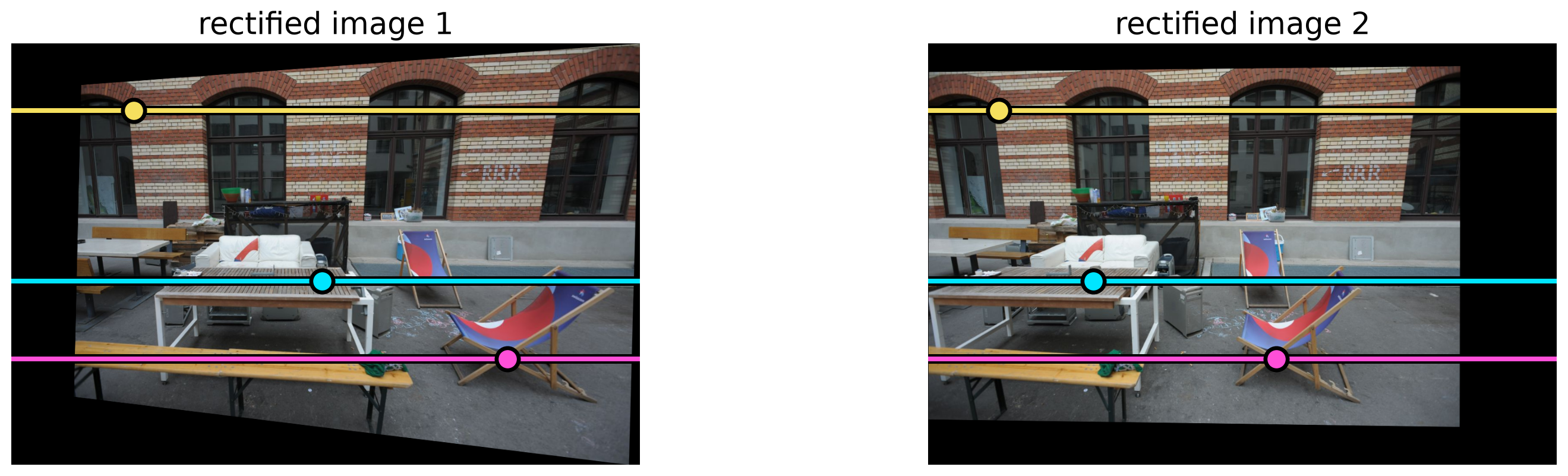
# R, t: pose of camera 2 relative to camera 1
R1, R2, P1, P2, Q, _, _ = cv2.stereoRectify(
K, dist, K, dist, (w, h), R, t, alpha=1)
map1 = cv2.initUndistortRectifyMap(
K, dist, R1, P1, (w, h), cv2.CV_32FC1)
map2 = cv2.initUndistortRectifyMap(
K, dist, R2, P2, (w, h), cv2.CV_32FC1)
rect1 = cv2.remap(img1, *map1, cv2.INTER_LINEAR)
rect2 = cv2.remap(img2, *map2, cv2.INTER_LINEAR)K: calibration matrix;dist: lens distortion;(w, h): image size;R,t: pose of camera 2 relative to camera 1;alpha=1: keep all pixels (0: crop to valid pixels).R1,R2: rotations;P1,P2: new cameras;Q: for 3D later.map1,map2: for each rectified pixel, where to sample in the original image (computed once, reused for every frame).- Uncalibrated?
cv2.stereoRectifyUncalibrateduses \(\mathbf{F}\) and matches instead.
Block Matching: Search for Matches Along the Row

Block Matching
For each pixel \((x, y)\) of the left image: compare its \(W \times W\) window with the windows at \((x - d,\, y)\) in the right image for \(d = 0, \dots, D\), and keep the \(d\) with the lowest cost.
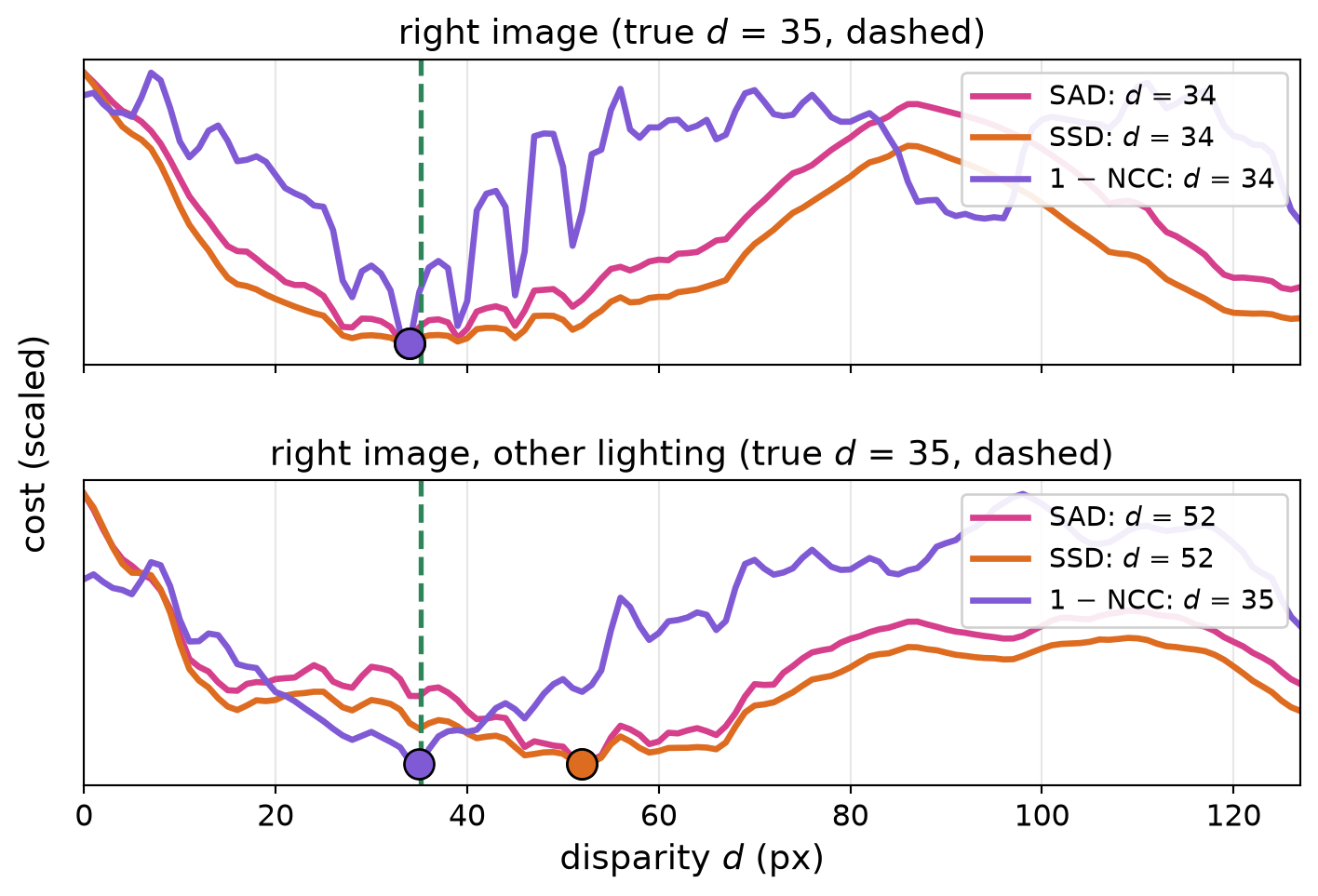
Matching Costs: SAD, SSD, NCC

Sums over the window; \(I_R\) is taken at \((x - d,\, y)\).
| Cost | Formula | Idea |
|---|---|---|
| SAD | \(\sum \lvert I_L - I_R \rvert\) | minimize absolute differences |
| SSD | \(\sum (I_L - I_R)^2\) | minimize big differences |
| NCC | \(\dfrac{\sum (I_L - \bar I_L)(I_R - \bar I_R)}{\sqrt{\sum (I_L - \bar I_L)^2 \sum (I_R - \bar I_R)^2}}\) | maximize correlation; brightness/contrast invariant |
The Cost Volume
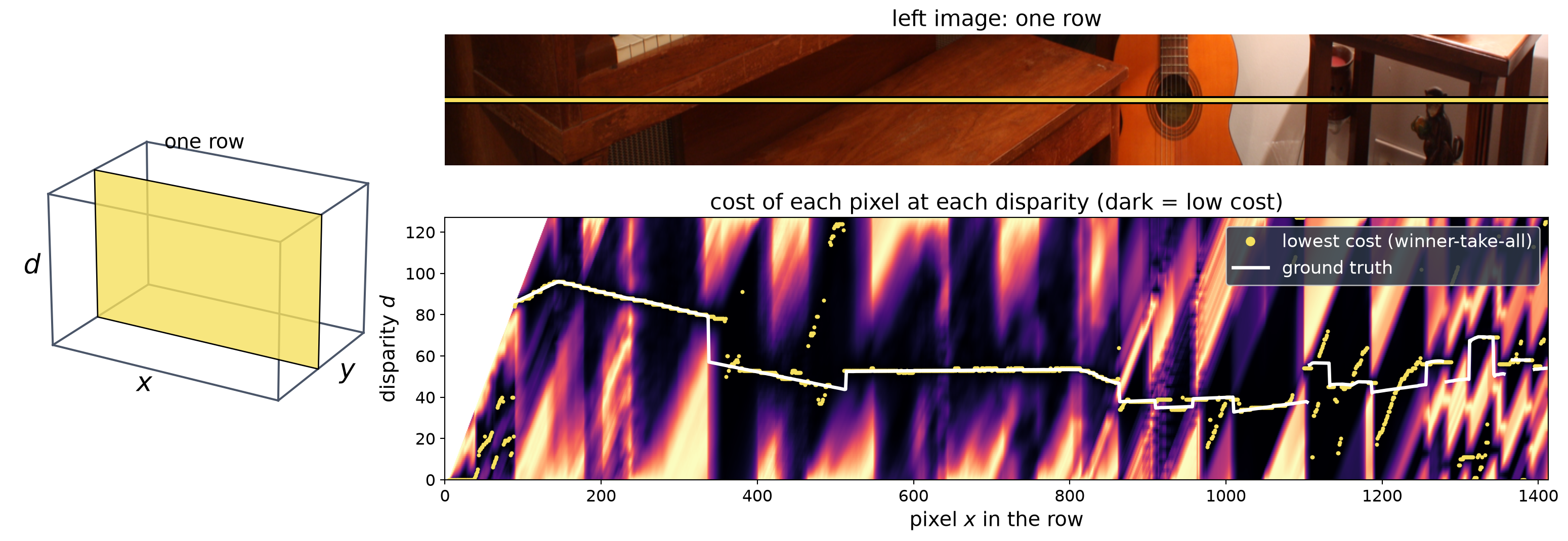
- Costs for every pixel and every disparity form a rows × columns × disparities cost volume.
- Winner-take-all: keep the lowest-cost \(d\) of each pixel \(\rightarrow\) the disparity map.
- Each disparity \(d\) is one depth \(Z = f\,b\,/\,d\).
Window Size Trade-Off
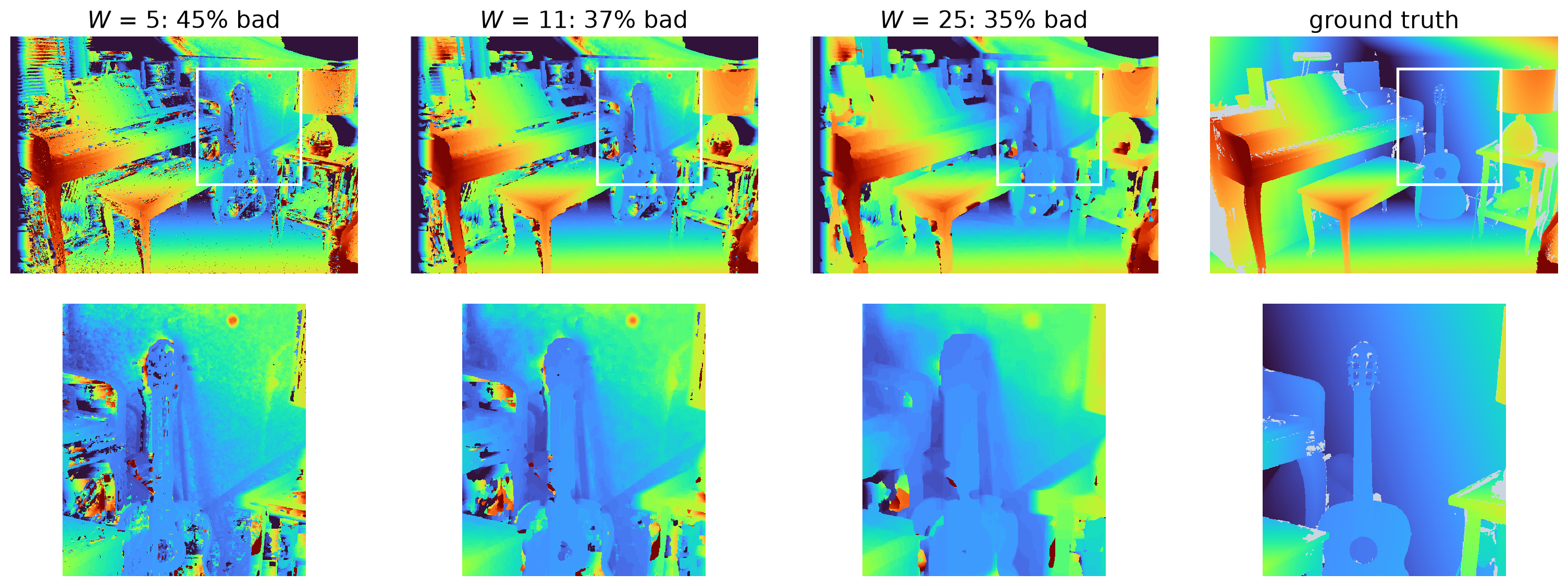
- Small window: detailed, but noisy.
- Large window: smooth, but blurs object boundaries (the window mixes two depths).
| Bad \(d\) estimate (> 2 px) | \(W\) = 5 | \(W\) = 11 | \(W\) = 25 |
|---|---|---|---|
| Flat regions | 46% | 38% | 34% |
| Near object boundaries | 41% | 35% | 39% |
Block Matching With OpenCV
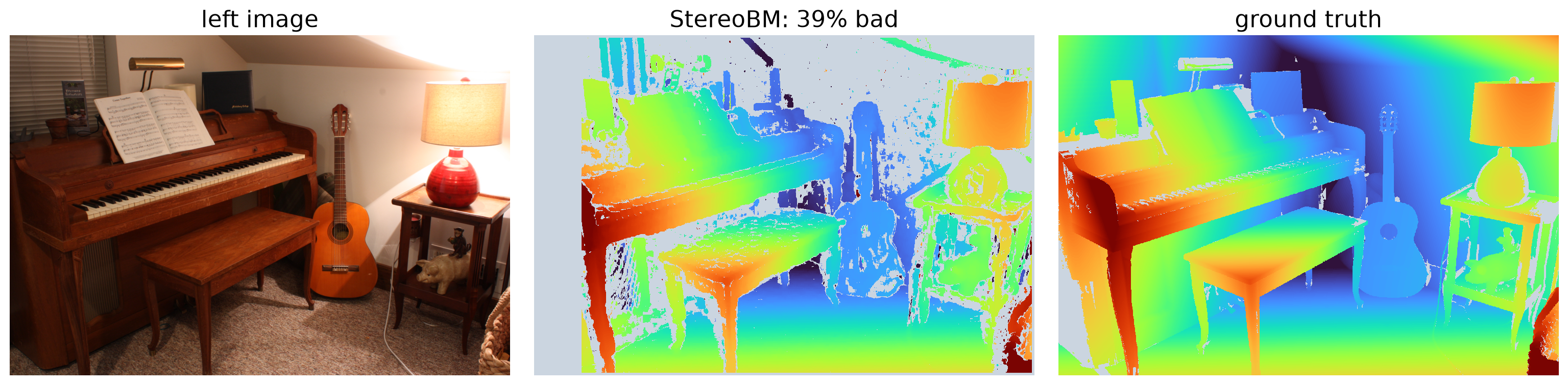
numDisparities: search range \(D\); OpenCV requires a multiple of 16.blockSize: window \(W\) (odd).Output is an integer equal to 16 × disparity (1/16 px precision): divide by 16.
Gray: no match (flat or unreliable areas).
16 ms for a 1414 × 962 image.
Adding Smoothness
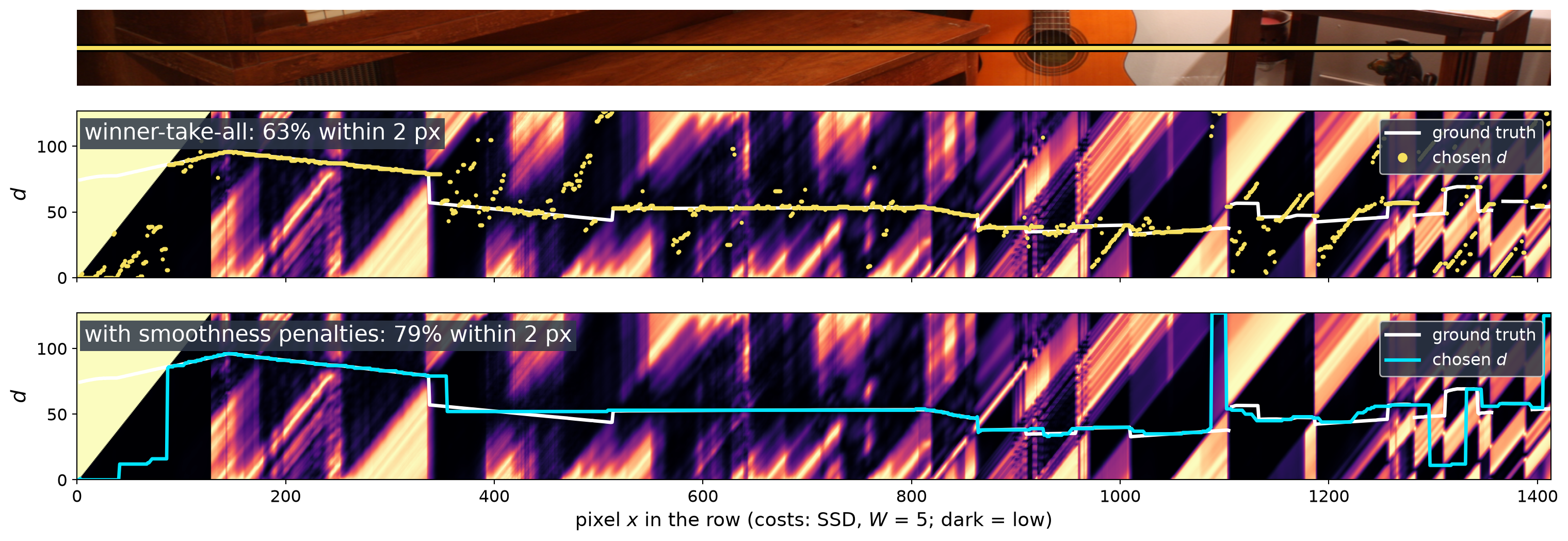
\[ E = \sum_{\mathbf p} C(\mathbf p, d_{\mathbf p}) \;+\; \sum_{\text{neighbors } \mathbf p, \mathbf q} \begin{cases} 0 & d_{\mathbf p} = d_{\mathbf q} \\ P_1 & |d_{\mathbf p} - d_{\mathbf q}| = 1 \\ P_2 & |d_{\mathbf p} - d_{\mathbf q}| > 1 \end{cases} \]
- Choose all \(d\) together: \(E\) is total disparity map cost; pick the map with the lowest \(E\).
- \(C(\mathbf p, d_{\mathbf p})\): matching cost of pixel \(\mathbf p\) at its chosen disparity \(d_{\mathbf p}\). \(\mathbf q\): a neighbor of \(\mathbf p\).
- Small \(P_1\): allows gradual changes (slanted surfaces). Large \(P_2\): a jump needs strong evidence (object edges, not noise).
Semi-Global Matching (SGM)
Semi-Global Matching
- Compute the cost volume \(C(\mathbf p, d)\).
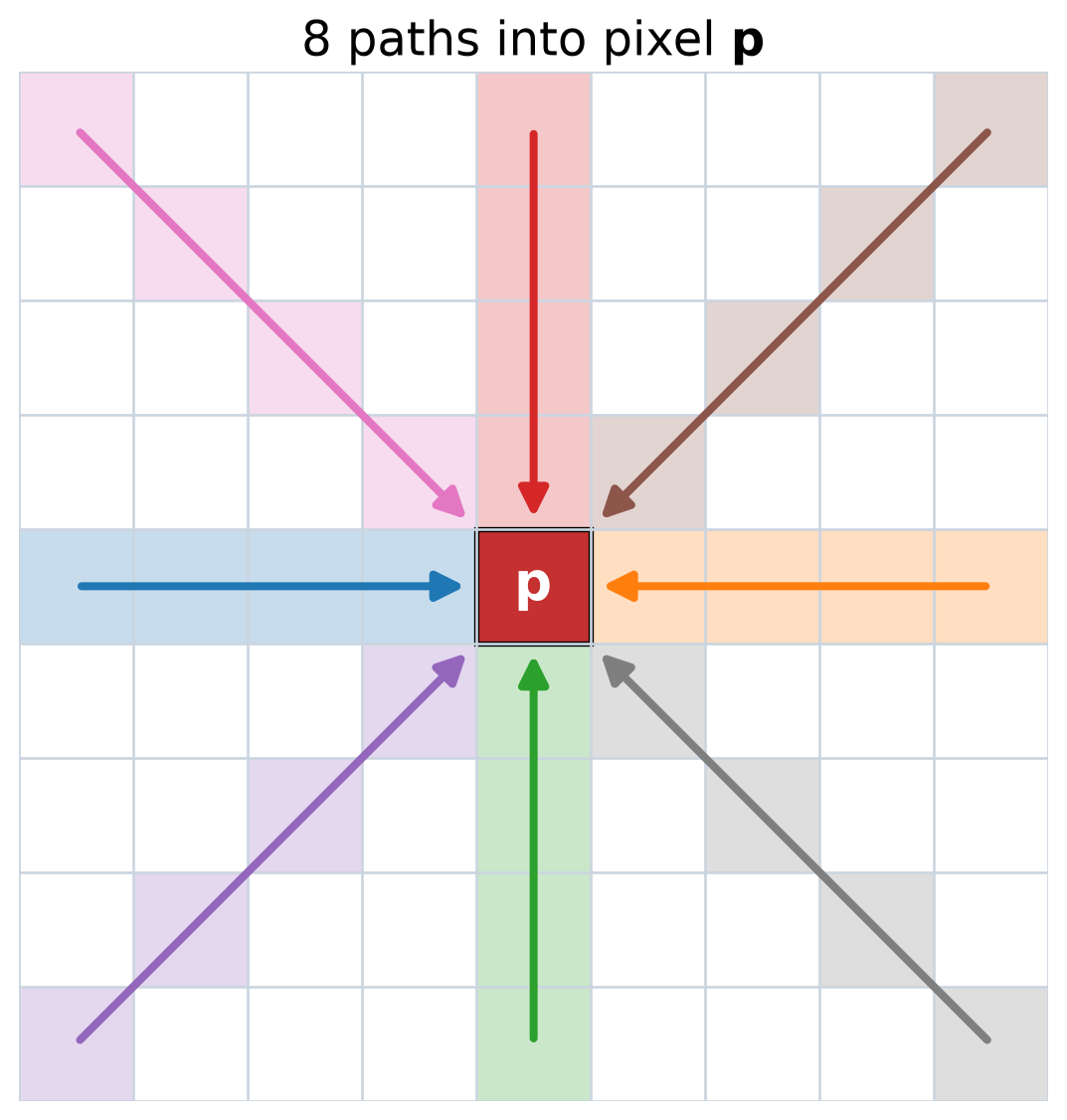
- Along each of 8 straight paths into every pixel (left → right, top → bottom, diagonals, …), add up the costs with the \(P_1\) & \(P_2\) penalties.
- Sum the 8 results: \(S(\mathbf p, d)\).
- Winner-take-all on \(S\): \(d_{\mathbf p} = \arg\min_d S(\mathbf p, d)\).
H. Hirschmüller, Stereo Processing by Semiglobal Matching and Mutual Information, IEEE TPAMI, 2008.
- The best \(d\) for the whole image at once is too expensive to find; 8 one-dimensional paths are a fast approximation: semi-global.
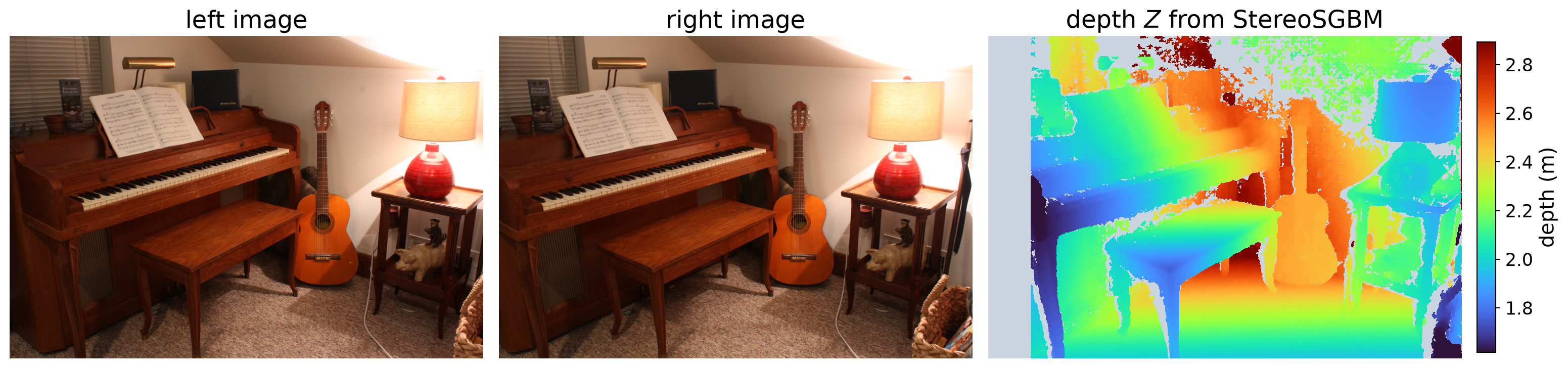
StereoBM vs. StereoSGBM in OpenCV

left = cv2.imread("piano_im0.png") # color: 3 channels
right = cv2.imread("piano_im1.png")
W = 5
sgbm = cv2.StereoSGBM_create(
minDisparity=0, numDisparities=128, blockSize=W,
P1=8 * 3 * W**2, P2=32 * 3 * W**2, # penalties
uniquenessRatio=10, speckleWindowSize=100,
speckleRange=2, mode=cv2.STEREO_SGBM_MODE_HH)
disp = sgbm.compute(left, right).astype(np.float32) / 16
disp[disp < 0] = np.nan # no match found| Bad pixels | Runtime | |
|---|---|---|
| StereoBM | 39% | 16 ms |
| StereoSGBM | 26% | 660 ms |
minDisparity,numDisparities: search range \(d = 0, \dots, 127\) px; must cover the nearest and farthest points.P1,P2: the smoothness penalties (\(\times\) channels \(\times W^2\), as suggested by OpenCV).MODE_HH: all 8 paths (the default mode uses 5, faster).uniquenessRatio,speckle…: drop unreliable matches (gray).
From Disparity to 3D
\[ Z = \frac{f\,b}{d}, \quad X = \frac{(x - c_x)\,Z}{f}, \quad Y = \frac{(y - c_y)\,Z}{f}; \quad \begin{bmatrix} X' & Y' & Z' & W \end{bmatrix}^\top = \mathbf{Q} \begin{bmatrix} x & y & d & 1 \end{bmatrix}^\top \]
- Go out along each pixel’s ray to depth \(Z\): one 3D point per pixel.
- The 4×4 \(\mathbf{Q}\) comes from
cv2.stereoRectify. - \((X, Y, Z) = (X', Y', Z') / W\).
Point Cloud With OpenCV
1,059,037 colored 3D points.
Holes: no match found.
Shadows behind objects: seen by only one camera.

left camera
top